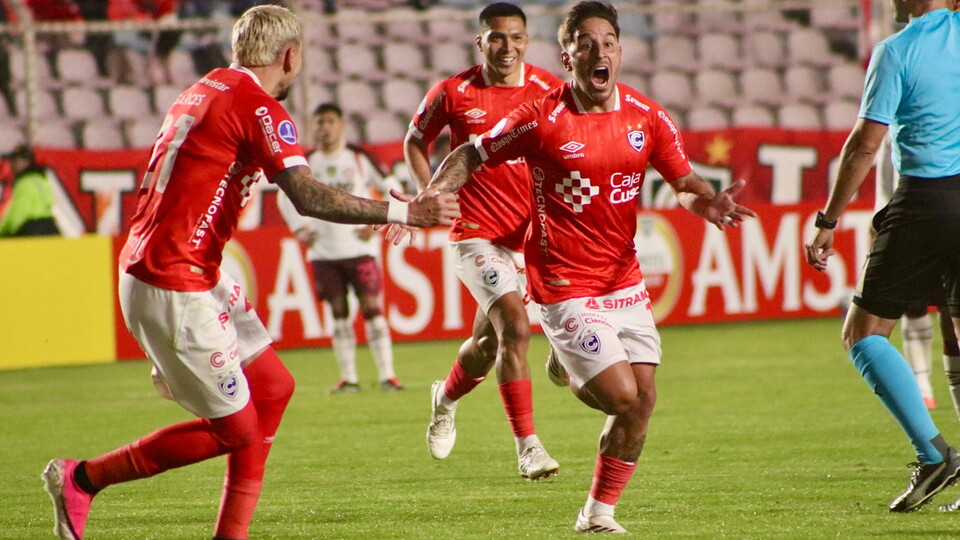
- The 34-year-old attacking midfielder scored twice in Cienciano’s 4-0 victory over Lanús, completing a remarkable comeback in Cusco and securing a place in the Round of 16.
- Grandson of Juan Eduardo Hohberg, a hero of the 1954 World Cup, and a champion with Alianza Lima, Universitario and Sporting Cristal, Alejandro has built a career deeply intertwined with Peruvian football.
Some surnames carry an epic legacy of their own. On the loudest of nights at the Inca Garcilaso de la Vega, Alejandro Hohberg lived up to his. A left-footed strike from outside the box in the 40th minute of the first half, followed by another goal deep into second-half stoppage time, completed his brace in Cienciano’s 4-0 victory over Lanús — the comeback that knocked out the reigning CONMEBOL Sudamericana champions and sent the Cusco side back into the Round of 16. At 34, the attacking midfielder produced one of the finest performances of his career. And in his case, the word “career” is tied to a remarkable family story.
The Hohberg story, after all, reads like something written for the screen. His grandfather, Juan Eduardo Hohberg, was the Uruguay forward who scored twice against Hungary in the semifinal of the 1954 World Cup and, while celebrating the equalizer, suffered a cardiac arrest. He was revived at the side of the pitch and returned to play extra time in that legendary match. An idol at Peñarol and later head coach of ‘La Celeste’ at the 1970 World Cup in Mexico — where he guided Uruguay to a fourth-place finish — Juan Eduardo eventually settled in Peru, coached some of the country’s biggest clubs and died in Lima in 1996, when his grandson was still taking his first steps.
Alejandro was born in Lima in 1991, moved to Uruguay at the age of seven and developed in the youth ranks of Peñarol, the club where his grandfather had become a legend. He made his professional debut with Rentistas, later played for Torque and, in 2014, took the opposite path to so many others by returning to the country of his birth. Peru embraced him almost immediately. After early spells with Melgar, San Martín and César Vallejo, his left foot earned him a distinction few players can claim: he wore the shirts of both giants of Peru’s biggest rivalry and won titles with each of them — becoming national champion with Alianza Lima in 2017 and winning the 2020 Apertura with Universitario — before adding the 2021 Apertura and the Copa Bicentenario with Sporting Cristal. Along the way, Ricardo Gareca called him up to the Peruvian national team, with whom he made his debut in 2016 and featured at the Copa América Centenario.
When many believed his story was entering its final chapter, Hohberg chose to reinvent himself. In 2025, he became captain and a leading figure for Sport Boys, producing nine goals and seven assists in just half a season, and in July of that year Cienciano brought him to the altitude of Cusco on a contract running through 2027. The idea was clear: experience, quality and goals for a continental dream. The left-footer more than delivered. During the Group Stage of this CONMEBOL Sudamericana, no Cienciano player attempted more shots than Hohberg, who registered a team-high 25 efforts and had already scored against Académica Puerto Cabello during the campaign that carried the club into the Playoffs.
But what happened last night was on another level. Trailing 2-0 after the first leg, Cienciano needed something extraordinary against the reigning champions, and Hohberg took charge of the comeback alongside Beto Garcés. Two goals apiece, with each also setting up the other, powered the 4-0 victory that completed the turnaround and sealed qualification. For the Cusco club, whose place in South American football history was forged by winning the 2003 Sudamericana against River Plate and the 2004 Recopa against Boca Juniors, there was also a nod to the past: another Argentine side fell in Cusco, this time at the hands of a player carrying a surname steeped in World Cup history.
The next challenge keeps the bar just as high. Botafogo, owners of the best record in the Group Stage, await in the Round of 16. Hohberg will be there too, the heir who spent years trying “not to live off what my grandfather did,” as he once admitted. After nights like the one at the Inca Garcilaso, he no longer needs to. His own story has earned the right to be told.