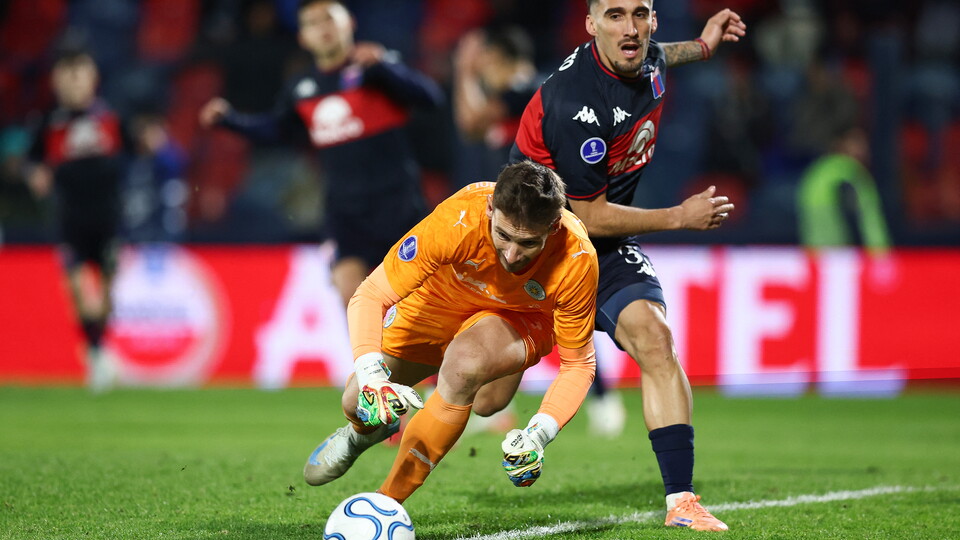
- In the summer of 2022, while he was playing for Everton de Viña del Mar, the goalkeeper was diagnosed with a malignant embryonal carcinoma.
- At 36, with five clean sheets in ten matches in the 2026 CONMEBOL Sudamericana, he is one of the reasons why Torque will face Mineiro for a place in the Final in Barranquilla.
“Every time you open up a test result, your hands start sweating and your heart rate shoots through the roof, because we’re talking about your health.” Franco Torgnascioli said it on 13 August on Radio Uruguay, one day after keeping a clean sheet in a victory over Tigre in Victoria. He is 36, the goalkeeper of Montevideo City Torque, and in November he is due to undergo the final check-up of a five-year monitoring protocol that began during the worst summer of his life.
Between that test and this one came a 3-0 comeback against Cienciano, a place in the CONMEBOL Sudamericana Semifinals — the first in the club’s history — and a way of understanding the profession that he sums up like this: “Goalkeepers have to deal with a lot of frustration. But in life, that ends up helping you, because it gives you a mindset that is quite well prepared for suffering.” It was a lesson he would later apply away from the pitch.
Torgnascioli was born on 24 August 1990 in Salto, Uruguay. He developed at Saladero, Peñarol de Salto and Ferro Carril before joining Danubio in 2007, made his top-flight debut with Boston River in March 2013 and won the Uruguayan league title with Danubio in the 2013/14 season. In 2016, he moved to Pachuca, beginning a decade of constant moves that would take him to Mineros de Zacatecas, Lorca in Spain, Everton de Viña del Mar, San Luis de Quillota and Unión Española. His final match of 2021 came on 4 December, a 3-0 defeat to Universidad Católica. During the holidays, a routine check-up detected a tumour.
Everton’s statement on 2 February 2022 left no room for euphemism: “malignant embryonal carcinoma”. What followed was emergency surgery, a three-week course of chemotherapy and, if everything went according to plan, an expected return by the end of April. Torgnascioli approached it as he did his matches. “I took it very well, calmly, and acted quickly,” he told Publimetro a year later.
Ahead of schedule, on 7 March 2022, he returned to training and wrote on social media: “Today is a very special day. After some time away from the pitch, I returned to training. Thank you to everyone who took the time to send me so much energy to face this process. Happy to be back with my beloved Everton.” In May, he was back in goal.
Carrying those lessons with him, and with a body that was no longer quite the same, Franco faced a demanding professional challenge: to keep going and earn his place all over again. “I had an illness that requires check-ups for five years. After that, they discharge you. Once the tumour was removed and I had chemotherapy, I was already cured, and now the check-ups are preventive. I live a normal life,” he explained in 2023. That normal life included a loan spell at San Luis, a return to Everton, two seasons with Unión Española and, in 2025, a move back to Uruguay after ten years abroad to play for Torque. “I had cancer when I was going through a good moment, and you have to get back up and fight for your place again,” he said in August.
He fought for that place and won it. In the 2026 CONMEBOL Sudamericana, Torque won their group with 13 points, finishing above Grêmio, Palestino and Deportivo Riestra, eliminated Tigre in the Round of 16 and overturned a 2-0 first-leg deficit against Cienciano with a 3-0 win at the Centenario in the Quarter-finals, thanks to two goals from Salomón Rodríguez and a stoppage-time strike from Nahuel Da Silva. Torgnascioli started all ten of the Citadinos’ matches in the continental competition, conceded eight goals and kept five clean sheets. Against Cienciano, with the aggregate score still at 2-0, he produced a crucial save from Bandiera and tipped a Martinich free-kick bound for the top corner behind for a corner, at a moment when a Peruvian goal would have killed off the comeback before it had even begun.
Marcelo Méndez, the coach, described his team that night in the press conference with an idea that could hardly fit his goalkeeper any better: “For a coach, seeing your players give everything is the most rewarding thing there is.” He added in the same vein: “We are a human group, we are all pulling in the same direction, regardless of whether someone plays or not, or what role each person has. Today we have directors, cooks and maintenance staff here with us. That shows what this club is about: everyone together and all pulling in the same direction.”
Torgnascioli is one of the senior figures in the squad and, alongside captain Gary Kagelmacher, is responsible for the pre-match team talks. Beyond the comeback against Cienciano, one of the turning points in City Torque’s best-ever continental campaign was the 1-0 win in Victoria. Recalling that night, the goalkeeper explained how his motivational message to his team-mates came about: “I’m not someone who plans a team talk. I just say whatever comes from the heart in that moment.” His life experience and many years in the game make his leadership feel entirely natural.
The first leg of the Semifinal against Atlético Mineiro will be played on 14 October in Belo Horizonte, with the return fixture one week later. Torque are the only Uruguayan club among the eight semifinalists across the CONMEBOL Libertadores and CONMEBOL Sudamericana. Waiting for them will be a side that reached the CONMEBOL Libertadores Final in 2024 and the CONMEBOL Sudamericana Final in 2025, now coached by Eduardo Domínguez.