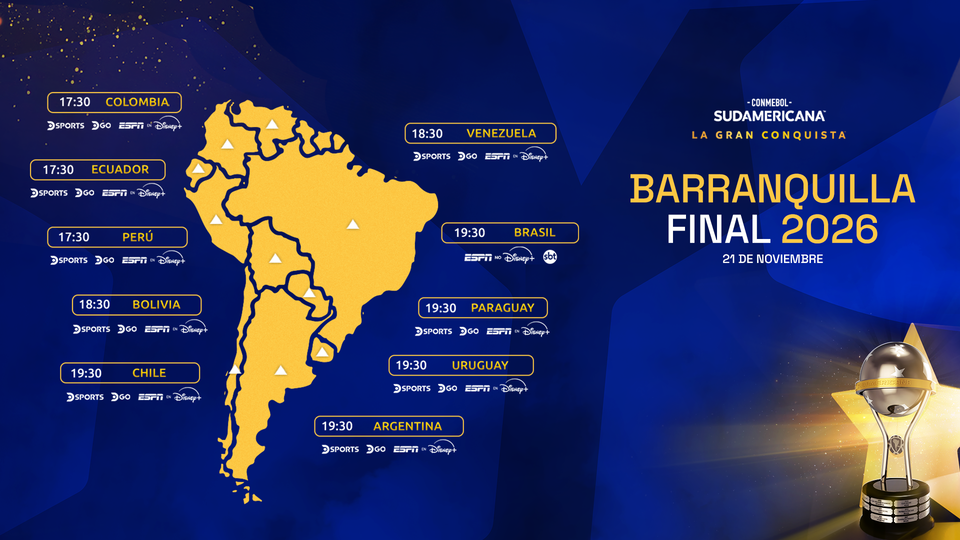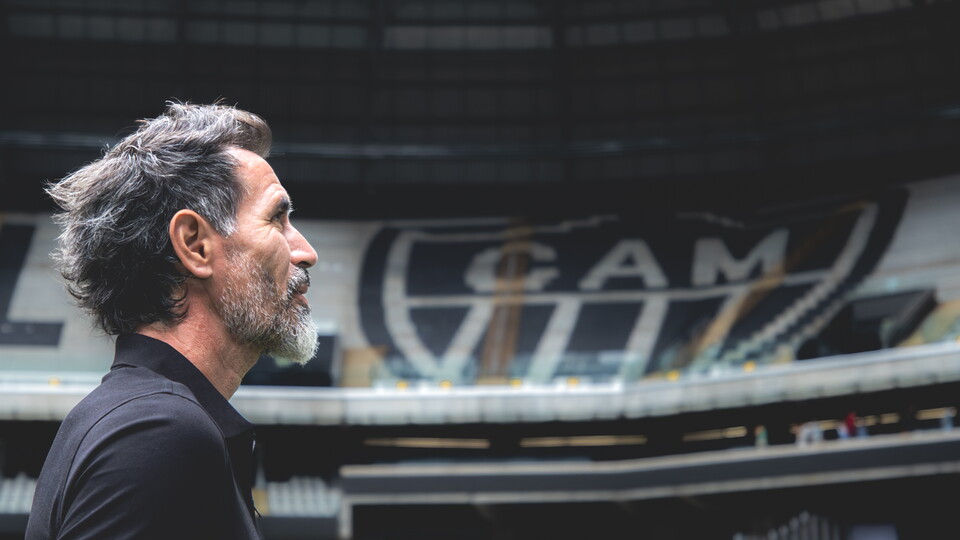
- Atlético Mineiro's Argentine coach spoke with CONMEBOL ahead of the Final on Saturday, November 21, in Barranquilla against Boca Juniors.
- His analysis of the opponent, adapting to Brazilian football, studying Portuguese, the books Gustavo Scarpa recommends and the perspective of his father-in-law, Carlos Bianchi.
Eduardo Domínguez arrived in Brazil with a language to learn, a relentless calendar and a football culture different from the one he knew. Today he is leading Atlético Mineiro into the CONMEBOL Sudamericana Final and, between matches and trips, he finds time to study Portuguese with a private teacher and read the books one of his players recommends.
'Galo', also finalists in the last edition, will face Boca Juniors on Saturday, November 21, at the Estadio Metropolitano Roberto Meléndez in Barranquilla. In an exclusive interview with CONMEBOL, the Argentine coach analyzed the opponent, explained what his team will need to focus on and described how he is living, far from home, the most demanding stretch of the year. It will be his second Final in the tournament, after the one he coached with Huracán in 2015, and it comes with a twist of its own: he is married to Brenda Bianchi, daughter of Carlos Bianchi, the multiple title-winning coach with Boca, his opponent in the decider of 'La Gran Conquista'.
CONMEBOL: What does reaching this Final mean to you?
Domínguez: First of all, I'm very happy to have made it here. It's a different culture, I had to get used to different day-to-day situations, with the travel, with so many matches in a year. So reaching an international final with the team makes me very happy, but what we expect is to win. Simply that.
CONMEBOL: How do you see the opponent?
Domínguez: We know it's a difficult one, one of the biggest clubs in Argentina and one of the biggest on the continent too. It has many trophies, some of the best players, a great coach, a very important history. We know the difficulties we're going to face, but we trust our team and our players. I believe in them a lot and we arrive in very good shape.
CONMEBOL: Where could the key to the match be?
Domínguez: What we have to focus on is the difference between Argentine football and Brazilian football. In Argentina there are a lot of duels, much tougher than here. We have to be strong in the head, mentally strong, so the body can fight for every ball the way the Argentines do. If we're focused on the kind of match they're used to playing, it's going to be an even match.
CONMEBOL: How was your adaptation to Brazil?
Domínguez: It's never easy to adapt to another culture and, above all, to the language. It's the only country in South America where another language is spoken, and that alone is a big difficulty. I'm trying to study, to get used to the culture, the language and, above all, to how the Brazilian football calendar is organized. Lots of matches, lots of travel. We also reached the final stages of the Copa do Brasil, and it was almost two months without stopping, with decisive matches every week. It creates a lot of stress and you have to change the team a lot. You need the players to understand the situation and you need a competitive group. Our group is very strong mentally, and with that we can create the ideal conditions to reach the deciding stages.
CONMEBOL: You're speaking Portuguese well. Are you studying?
Domínguez: Thank you for saying that, but it's very hard and I'm studying a lot, with a private teacher. I was already studying before I came, because I felt it was a step I wanted to take in order to grow, not only professionally but personally too. I wanted to take that step in my life and I'm very happy.
CONMEBOL: Are you reading in Portuguese too?
Domínguez: That too. It's a bit harder, because there are a lot of words I don't know. Gustavo Scarpa is starting to take those steps for reading. The world of football can help a lot of people, and he is building a brilliant idea. He recommended The Shack to me and I've already read it. As I told him, I cried, because it's a beautiful story. It's tiring, because there are a lot of matches and a lot of travel, and in the middle of it all you have to study, read and prepare the team. I'm giving it my best effort.
CONMEBOL: Your father-in-law, Carlos Bianchi, follows your career closely. What place does he have in it?
Domínguez: I'm very grateful for my father-in-law's words. He is always very close to my career, but he also tries to stay a little on the outside, at an interesting distance, so that I don't make the mistakes he made and because the path is my path.
CONMEBOL: How would you define the way you work?
Domínguez: The first thing is listening to the player. Listening to what they're feeling, how they're behaving, how they're playing and training. Sensing that is very important to me. From there I can make the changes that I feel too, along the way. But the most important thing for me is listening to the player.
CONMEBOL: Have you been able to get to know Belo Horizonte?
Domínguez: Very little. I'm far from the city, close to the training center. With the run of matches and the travel it's very difficult, and on the day off I prefer to rest at home. I've been on my own since my family went back to Buenos Aires. They made the effort to be here with me, but my children are at an age when they need their friends and family. Everyone is making the effort so that my dream and the family's dream can succeed.
CONMEBOL: Not even a pão de queijo or a tropeiro yet?
Domínguez: Not yet. But I do know that pão de queijo comes from Minas.